Your ring buzzes at 6:40 in the morning and tells you your blood pressure trended high overnight. You stand in the kitchen deciding whether to call a doctor or finish the coffee. Here is the part nobody prints on the box: as of January 2026, that number can reach your finger without a single regulator ever checking whether it is accurate.
The reversal nobody announced
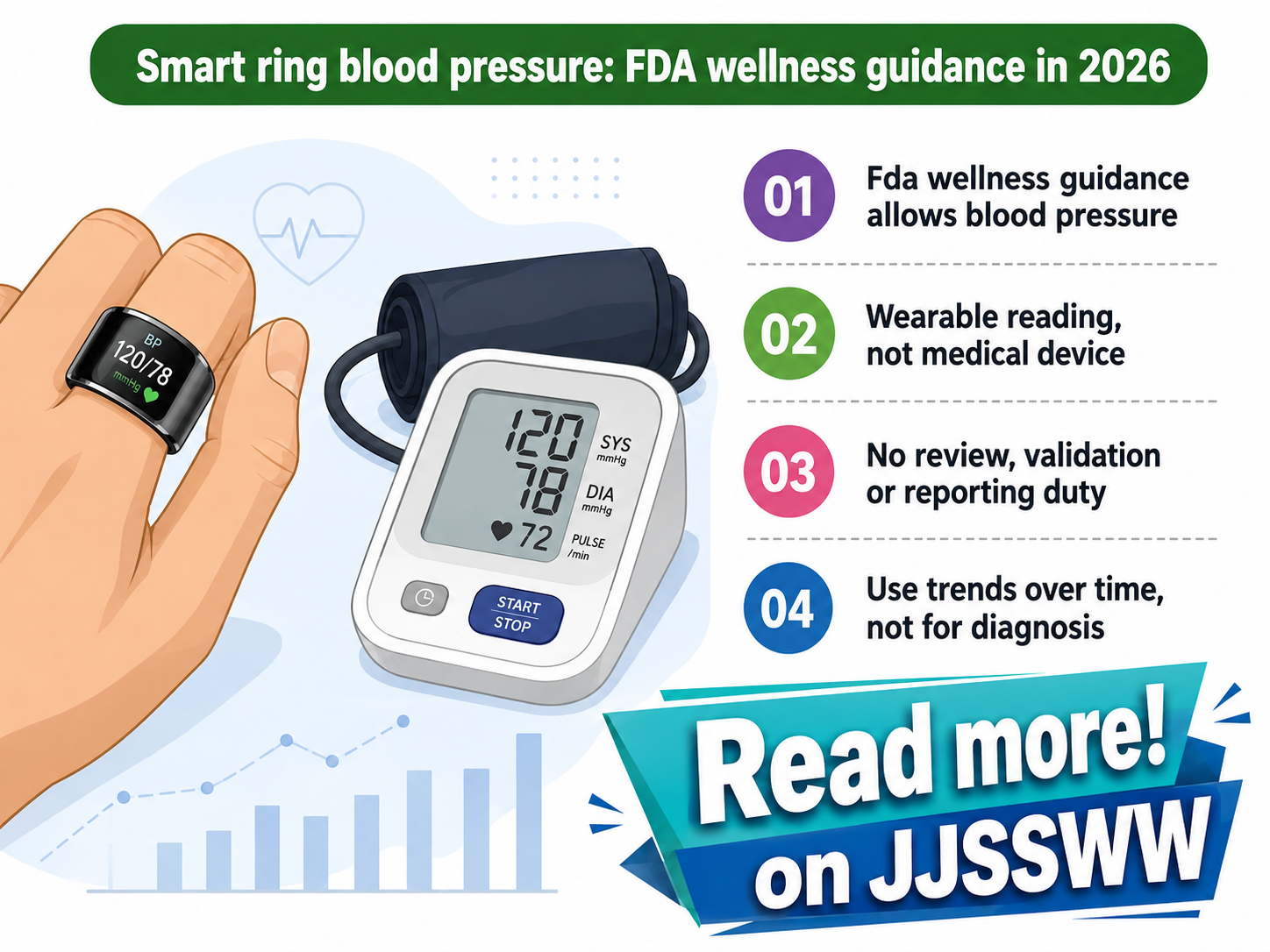
In September 2025 the FDA published a safety communication saying flatly that blood pressure measuring devices are required to receive marketing authorization to be sold lawfully in the United States, and that they do not fall inside the agency's general wellness policy. Two months before that it had sent Whoop a warning letter over its blood pressure feature. The position looked settled. Then the agency rewrote its "General Wellness: Policy for Low Risk Devices" guidance in January 2026 and said the opposite: a noninvasive product that estimates blood pressure can be a general wellness product after all, provided it is intended solely for wellness use.
And the sensors did not improve in between. The hardware on your finger in February was the same hardware that was on it in August. What changed was the paperwork question the FDA asks first, which is now about intended use rather than about what the device physically measures. The agency frames this as applying its own policy more faithfully. That reading is defensible. It is also, in practice, a loosening, and calling it anything else does readers no favours.
Being outside the device definition is worth a great deal to a manufacturer. No premarket review. No registration and listing. No device labelling requirements. No medical device reporting when something goes wrong, which also means no public failure database for anyone to search later. And FDA's February 2026 cybersecurity guidance, with its demand for a cybersecurity management plan, simply does not bind a product that is not a device. Regulators stepping back while a consumer product quietly takes on more responsibility is a pattern this site has watched play out with telecom support and TRAI, and the shape of it is familiar.
Policy Reversal
4 months
from prohibited to permitted
Capital Raised
$900M
Ōura, October 2025
Units Shipping
4.9M
smart rings, 2026 forecast
Category Growth
12.8%
year over year, per IDC
The money figure is the one that explains the timing. Ōura raised $900 million in October 2025, according to MedTech Dive, and in the same month said it had institutional review board approval to run a US study validating a blood pressure feature it has not yet shipped. A company can now put an estimate in front of millions of users under wellness rules while it pursues clearance for the medical version on a slower track. Both paths run at once, and only one of them has to prove anything before launch.
Four months separated "you need authorisation to measure blood pressure" from "you don't." Nothing about the sensor on your finger changed in between.
Wellness number versus medical number
Two readings can look identical on a screen and mean completely different things. The distinction is not about display accuracy, it is about what somebody had to prove before you saw the figure at all.
| Dimension | Wellness Wearable | Cleared BP Device |
|---|---|---|
| Premarket review | None required | Required before sale |
| Accuracy proof | Manufacturer's own claim | Validated against a standard |
| Disease language | Prohibited entirely | Permitted within labelling |
| Alerts | Generic "see a professional" only | Clinical thresholds allowed |
| Failure reporting | No public reporting duty | Reportable to the FDA |
| Cybersecurity rules | FDA guidance does not apply | Management plan required |
| A high reading means | Something moved. Unknown what | A measurement a clinician can act on |
| Best Suited For | Spotting your own week-to-week drift | Any decision involving medication |
Read the bottom row twice. A wellness wearable is genuinely good at the thing a cuff is bad at, which is noticing that this month looks different from last month while you sleep. It is not equipped to tell you what that difference is, and under these rules it is not allowed to try.
The timeline above runs left to right: enforcement in July 2025, a public demand for clearance in September 2025, that demand withdrawn for wellness-intended products in January 2026, and a February 2026 cybersecurity rulebook that never reaches them.
Where this gets slippery
The weak joint in all of this is that the category is decided by language. The FDA judges intended use objectively, from labelling, advertising and any other statement a company makes, which means two rings with identical sensors can land on opposite sides of the line based on their marketing copy. That is a workable legal test. It is a strange basis for a consumer to judge whether a number is trustworthy, since the shopper sees the box, not the regulatory filing.
There is an unresolved question underneath this that no guidance document settles, and I do not think anyone has a clean answer yet. A number formatted like a clinical reading gets treated like one, whatever the disclaimer says. Telling someone their systolic trend is elevated while insisting this is not a medical statement asks a person to hold two ideas at once at 6:40 in the morning, before coffee. My view, and it is only that: the label governs the manufacturer's liability far more than it governs the user's behaviour.
- Invasiveness still disqualifies, regardless of intent. The guidance's own new example of a microneedle glucose estimator stays regulated, because anything that pierces skin is not low risk by definition.
- Alerts are boxed in tightly. A wellness product may tell you to consult a professional, but it cannot name a condition, call a result abnormal, or offer ongoing monitoring for medical management.
- Dropping out of device status does not drop the data risk. HIPAA can still attach when a tracker integrates with a provider, the FTC has pursued wellness manufacturers over weak security, and every US state has breach notification law waiting.
- Trust in an automated reading tends to outrun what the system has earned, the same gap that shows up when people decide how much to let an AI shopping agent spend on their behalf.
Key takeaways before you trust the number
Check whether the feature says "estimate" or "measure". That single word is usually where the regulatory status is hiding.
No device status means no malfunction reporting duty, so there is no public record to check when a feature turns out to be wrong at scale.
Bring the trend, not the number, to your doctor. A month of overnight readings is useful context. One morning's figure is not evidence.
Buy the ring if you want it. Just decide now, while nothing is wrong, that a wellness reading gets you a doctor's appointment and never a decision, and keep a cuff in the drawer for anything that actually matters. The rules changed in your favour as a shopper and against you as a patient, and only one of those is on the packaging. Governments have mandated humbler safeguards than this in consumer hardware before, which is exactly the argument for mandated battery tracking in ICE cars.
No comments
Post a Comment