You add one item to a quick-commerce cart late at night. The bill lands higher than the things you picked, and the extra sits under a collapsed line labelled handling. You tap pay anyway, because unpicking it would take longer than the delivery. That is the transaction the government has spent nearly three years trying to regulate, and it is still the transaction most Indians complete every week.
Why It Matters
Dark patterns are not a vague complaint about bad design. They are a named, listed category of unfair trade practice in Indian law, covering everything from false urgency and basket sneaking to the subscription trap and the grey "no thanks" button engineered to be missed. That list matters because it converts a design argument into an enforcement question. Once a practice has a legal name, the only thing standing between you and a refund is whether anyone bothers to use it.
Enforcement, it turns out, is the whole story. The rules are written well. They cover the exact behaviours a shopper actually meets: the pre-ticked insurance, the fee that appears at the last screen, the trial that quietly needs a card. If you have followed the argument about what happens when an AI shopping agent buys the wrong thing on your behalf, this is the same problem one layer down. The interface is already optimising against you before any agent gets involved.
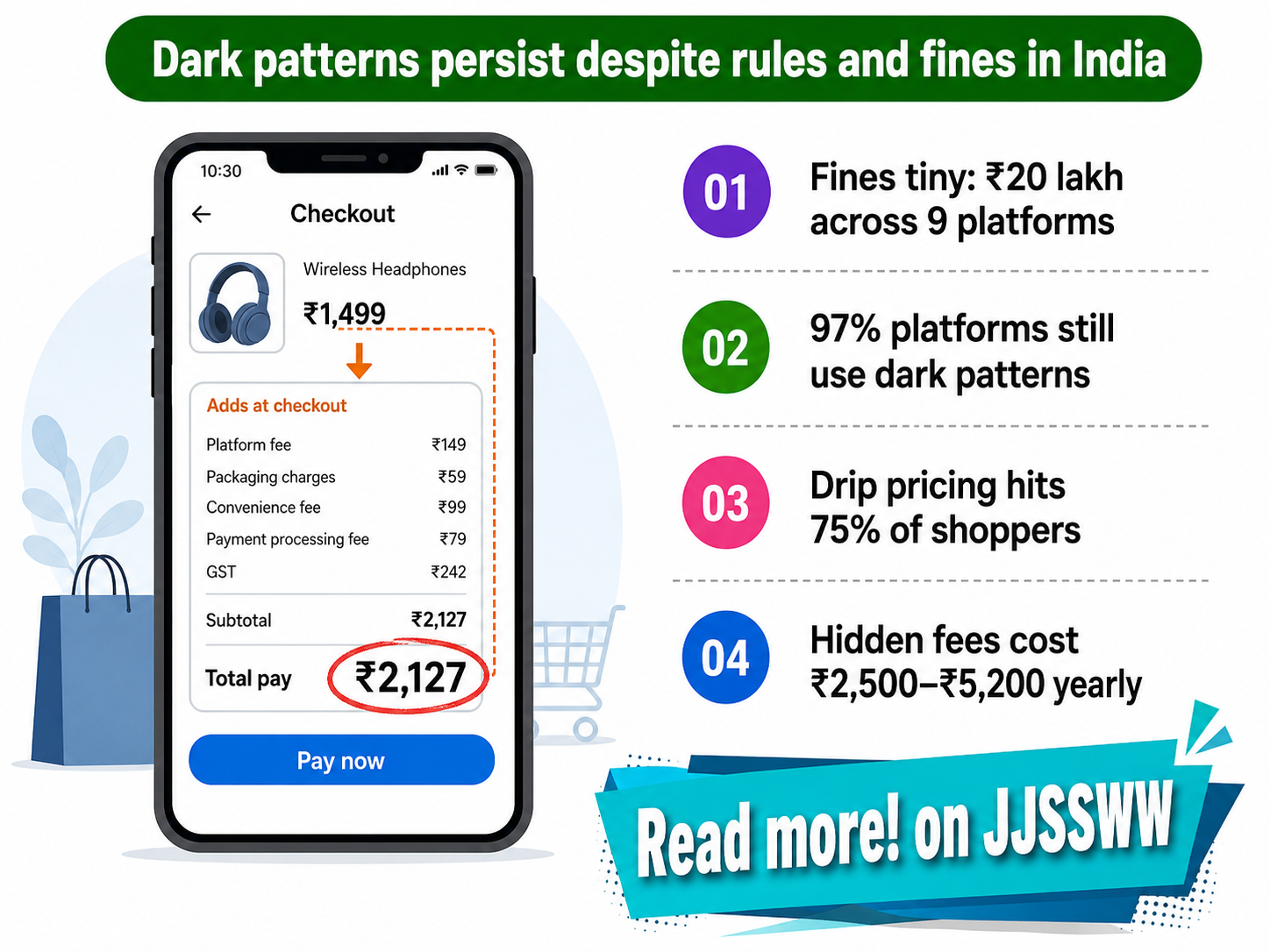
And the numbers make the gap plain. In a written reply to the Rajya Sabha on 6 August 2026, Minister of State for Consumer Affairs B. L. Verma put the total penalty the Central Consumer Protection Authority has imposed for dark patterns at twenty lakh rupees, spread across nine platforms including IndiGo, Zepto, FirstCry, BookMyShow and Physics Wallah. Nine names, one sector, one combined figure smaller than a single mid-tier marketing campaign. Set that against the money these interfaces move, or against the way scattered subscription pricing quietly raises what you pay each month, and the scale problem stops being subtle.
Self-audit window
3 months
given to platforms in 2025
Annual take
Rs 25,000 to 28,000 cr
estimated yearly revenue
Patterns prohibited
13
each defined in the guidelines
Still using them
97%
of 290 platforms audited
The self-audit window is the number worth sitting with, because of what a self-audit actually is. The regulator asked platforms to inspect their own interfaces, decide for themselves whether anything on the prohibited list was present, and send in a letter saying what they found. No inspection. No template. No requirement to show the before and after. A company can conclude in good faith that its checkout is compliant, file the letter, change nothing, and be entirely within the process as designed. That is not a loophole somebody discovered. That is the process.
Twenty lakh rupees, spread across an entire sector, is not a deterrent. It is a line item, and everyone drafting the next checkout flow already knows it.
What The Record Actually Shows
Pull the timeline together and a pattern emerges that has nothing to do with interfaces. Every step in this story is a document: a notification, an advisory, a declaration letter, a parliamentary reply. Almost none of it is an inspection. The table below is the whole enforcement arc as it stands today.
| Category | Detail | Insight |
|---|---|---|
| Rulebook | Guidelines notified 30 November 2023, binding on sellers and platforms alike | Old rules, only recent enforcement appetite |
| Self-audit | CCPA advisory of 5 June 2025 told platforms to audit themselves | The graded party marks its own paper |
| Declarations | 26 platforms filed letters, Flipkart, Myntra, Swiggy and BigBasket among them | Paperwork filed, interfaces mostly untouched |
| Late filing | Amazon Seller Services submitted its declaration on 19 February 2026 | Well past the window, with no consequence |
| Persistence | MediaNama logged live false urgency and nudge popups in April 2026 | Declaration and behaviour did not match |
| Outlier | Meesho was the only platform to clear every check in the LocalCircles audit | Proof the tricks are optional, not structural |
| Redress | The National Consumer Helpline takes dark-pattern complaints before any court stage | A free lever, if you know it exists |
One row in there is doing more work than the rest. Meesho clearing every check kills the standard industry defence, which is that hidden fees and pre-ticked boxes are simply how modern commerce funds thin margins. A platform of comparable size ran the same audit and came out clean. So the tricks are a choice, made by a growth team, signed off by somebody, and reversible by the same people who added them.
Share of shoppers reporting each pattern in the LocalCircles audit, which combined 77,000 responses from 334 districts between June and September 2025. Drip pricing leads by a wide margin, reported by three quarters of respondents. Bait and switch and non-consensual data use sit close together near the halfway mark, and basket sneaking trails at roughly a fifth.
Friction Points
Here is where I break with the usual take. Most commentary treats every prohibited pattern as equally worth chasing, which reads well and enforces badly. They are not equal. Drip pricing is the one that takes money from nearly every shopper on nearly every order, and it is also the easiest to prove, because the gap between the advertised price and the final bill is a screenshot. Confirm shaming and nagging are genuinely unpleasant and cost almost nobody anything. A regulator with a small team should be spending its attention where the rupees are, not distributing it evenly for the sake of looking thorough.
The second problem is timing. A fine arrives long after the pattern has finished paying for itself, which makes the penalty a retrospective tax on a completed profit rather than a brake on starting. The rules are not weak. Or rather, the rules are fine and the machinery behind them is not, which is a different failure and needs a different fix. Nothing in the current design makes a product manager pause before shipping a pre-ticked box, and until something does, the incentive runs one way. India has form here: the country waited years for basic consumer infrastructure that other markets take for granted, from repair access to an official refurbished store for Apple hardware, and the delay was never about the absence of rules.
Subscription traps deserve their own note, because they compound. A trial that quietly needs a card, plus a cancellation flow buried several screens deep, together produce a charge you never decided to make. That is the same consolidation pressure visible in India's streaming market as the big platforms merged, except at the level of a single toggle. Watch for these:
- The final total at checkout, not the price on the product page.
- Any pre-ticked add-on: insurance, donation, priority delivery, extended warranty.
- A scarcity label with no expiry time attached to it.
- A free trial that asks for card details before it starts.
- A decline option rendered in grey text while the accept button is bright.
Key takeaways: what this costs you
- Hidden fees run roughly Rs 50 to Rs 100 on a typical e-commerce transaction.
- Across a year that lands between Rs 2,500 and Rs 5,200 for a regular shopper.
- 62 per cent of quick-commerce users have lost money to subscription traps or basket sneaking.
- 41 per cent of surveyed shoppers had never heard of the consumer regulator or the term dark patterns.
Figures from Datum Intelligence, Dark Patterns in India's Online Marketplaces, June 2026.
So treat the crackdown as a signal, not a shield. The next time your total jumps at the last screen, screenshot the product page and the final bill, then file the pair with the National Consumer Helpline. Complaints are the only input this system actually responds to, and right now it is receiving almost none.
Related: what actually happens when you file a TRAI complaint online
No comments
Post a Comment