Your broadband has been dead since Thursday. You have called the helpline four times, been promised a technician twice, and nobody has come. So you do the sensible thing and search for how to file a TRAI complaint online, because TRAI is the regulator and regulators fix things. That search is where most people lose the next three weeks.
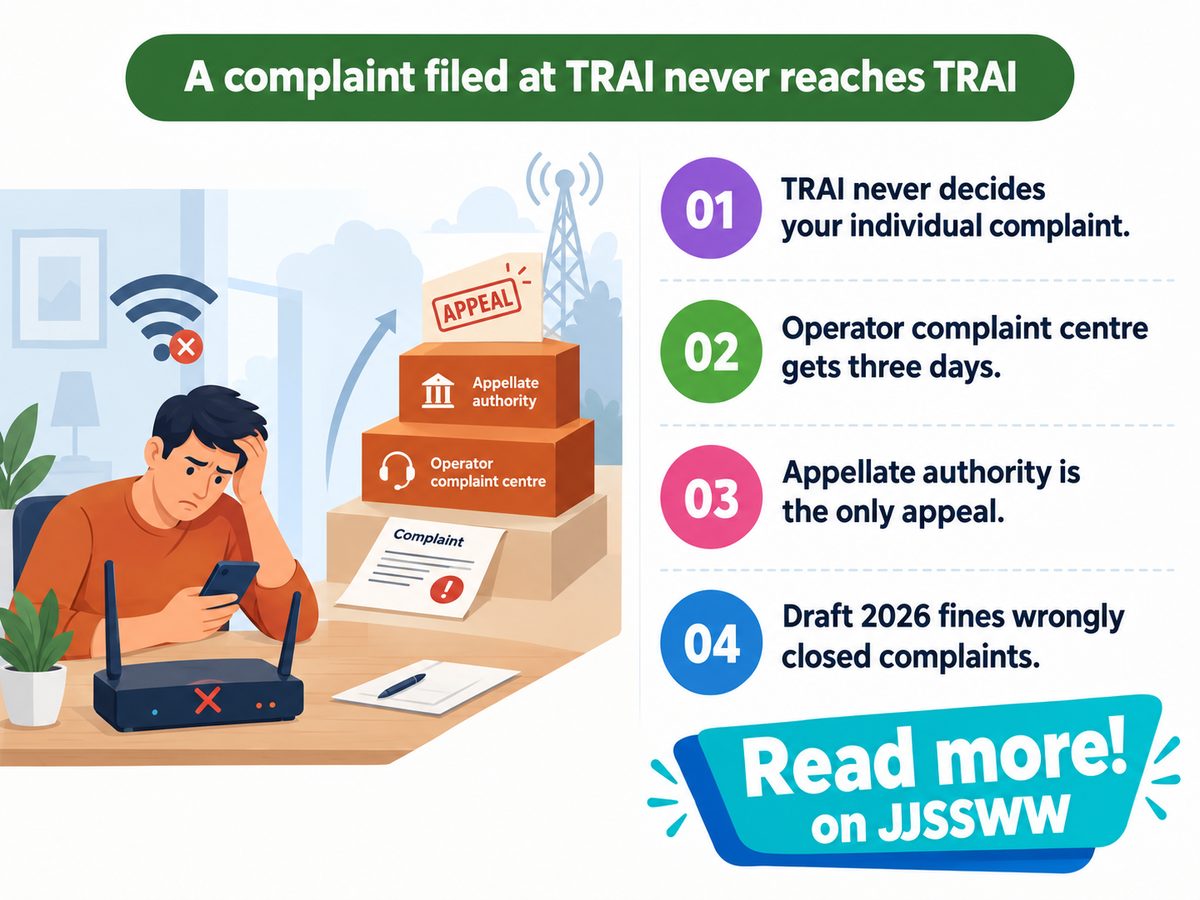
Here is the sentence that changes the plan, and it sits on TRAI's own FAQ page: "It is clarified that individual consumer complaints are not handled by the TRAI." Not a policy position buried in an annexure. One plain line on the regulator's website. TRAI writes the rules your operator has to follow and audits whether they followed them. It does not read your ticket, or rather, it reads the aggregate of everyone's tickets once a quarter, which is a very different thing from reading yours.
A complaint filed at TRAI does not go to TRAI, and it never has.
- Your operator's complaint centre is the only body with a deadline to fix your problem.
- When that deadline lapses, the appellate authority inside the same operator is your second and last regulated step.
- A draft amendment dated 7 May 2026 would fine an operator every single time it closes a complaint improperly.
- That draft has not been notified. Until it is, you are working the rules written in 2012.
How Do You Complain To TRAI, And Where Does It Go?
You do not complain to TRAI. You complain to your operator's complaint centre, which owes you a resolution inside three days where no other quality of service timeline applies, and then to that operator's appellate authority.
That distinction sounds like bureaucratic hair splitting until you look at how many people trip over it. In Semrush's India database, retrieved on 7 September 2026, the phrase "trai complaint" pulls roughly 3,600 searches a month and "trai complaint online" another 880. Most of those people are typing the name of the one organisation in the chain that will not act on their case. They are not being stupid. They are being logical, and the system is not.
The standard advice on consumer forums is to escalate to TRAI when your operator stonewalls you. It is wrong, and it has been wrong since the parent regulation was notified on 5 January 2012. What TRAI actually gives you is a map: the Telecom Consumer Complaints Monitoring System lists every operator's complaint centre and every appellate authority, circle by circle. A map is useful. It is not a judge.
This has the same shape as the enforcement gap behind India's dark pattern crackdown and what it actually changed for online shoppers. A rule exists, the body that enforces it sits somewhere the consumer does not expect, and the distance between those two facts is where people give up. Billing disputes follow the pattern too, which is why the specific dates behind staggered streaming price increases and when your bill actually changes end up mattering more than the headline price.
The numbers below are the ones worth holding on to before you decide how much of your week this is worth.
Age of the ladder
14 years
Unchanged since January 2012
Late report ceiling
Rs 10 lakh
Cap on delay charges, draft
Monthly searches
3,600
For "trai complaint" in India
Daily meter
Rs 20,000
Per day after the first fortnight
The money that will actually change operator behaviour is not the per case fine. It is the daily meter on late quarterly performance reports, because that one runs whether or not a single consumer complains. A per complaint charge only bites when somebody appeals and wins. A reporting clock bites on a calendar, which is much harder to manage away, and finance departments respond to calendars.
TRAI says it in one line on its own website: individual consumer complaints are not handled by the TRAI. Every wasted week that follows starts with not reading that sentence.
So what would actually change if the draft on the table becomes law?
What A TRAI Complaint Online Costs You In Days
Under the rules in force, a complaint that runs the full distance can take about 72 days, and up to 132 if the appeal window is extended. The draft compresses that to about a month.
The document is formally the Telecom Consumers Complaint Redressal (Fourth Amendment) Regulation, 2026, dated 7 May 2026, and stakeholder comments closed on 5 June 2026. It leaves the two tier structure alone and goes after the two things that make the structure fail in practice: how easily you can get a complaint registered at all, and what it costs an operator to close one that should have stayed open.
| What Changes | In Force Today | Draft Of 7 May 2026 |
|---|---|---|
| Decision | Operator's complaint centre, then that operator's appellate authority | Unchanged, and TRAI still decides no individual case |
| Channels | Five: IVRS, web portal, email, post, in person | Seven, adding a mobile app and chatbots or AI agents |
| Complaint | No penalty specified for closing one improperly | Rs 1,000 for each improperly dismissed complaint |
| Appeal | No penalty specified for dismissing one improperly | Rs 5,000 for each improperly dismissed appeal |
| Ceiling | None, because no per case charge exists | Rs 50 lakh per licensed service area per quarter |
| Reporting | No standing duty to publish complaint performance | A Consumer Corner carrying quarterly performance reports and survey results |
| Best Suited For | A complainant with up to three months of patience | A complainant who needs an answer inside one month |
Those totals are our own arithmetic, not a figure TRAI publishes. Add the three day resolution window to the thirty day appeal window and the roughly thirty nine days the appellate authority currently takes, and you get about seventy two days end to end. Stretch the appeal window to its ninety day maximum and the same journey runs past four months. The draft cuts the appeal window to fifteen days and caps the appellate decision at fifteen more, so the same journey lands near thirty three. The trade is real and it is not free: you gain speed at the far end and lose half the time you had to notice the deadline in the first place.
Day markers are our arithmetic on the limits stated in TRAI's Draft Telecom Consumers Complaint Redressal (Fourth Amendment) Regulation, 2026, dated 7 May 2026.
How Do You Register A Complaint Against Airtel Or Jio?
The same way for either one. Every licensed operator has to run a complaint centre and name an appellate authority for each licensed service area, and you can look both up on TRAI's TCCMS portal before you file anything.
The brand on the bill changes nothing about the procedure, which is the useful part and also the frustrating part. There is no shortcut for a big operator and no penalty box for a bad one, at least not yet. What varies is how easy each company makes it to reach a human, and that variation is precisely what the draft's Consumer Corner would expose to anyone willing to read a quarterly report.
Worth saying plainly: I think the appeal window cut is the weakest idea in the draft. Fifteen days sounds tidy on paper. In practice a complaint that was quietly closed while you were travelling can burn most of that window before you notice, and the fix costs nothing to write. Keep the thirty day window and cap the decision at fifteen. You would get the speed without moving the risk onto the person with the least information, which is the same imbalance running through the case for and against handing AI shopping agents your wallet. The pattern repeats wherever a process is designed by the party that already knows how it works. Subscription billing does it too, as Google's scattered subscriptions and what they quietly cost shows.
Four things to watch for once you are in the process:
- A ticket marked resolved without your agreement still starts the appeal clock. The draft would make the confirmation message and its survey link the marker of closure, which helps only if you actually read the message.
- The appellate authority sits inside the operator. It is not independent and there is no separate ombudsman waiting behind it.
- Consumer courts stay open to you, but that is a different process with its own fees and calendar, and the telecom ladder does not feed into it.
- If the problem is unwanted calls or messages, that runs on the Do Not Disturb rules and a separate register, not on this ladder at all.
Do these before you need any of it.
Ask for the docket number. Say it out loud on the call. Without one, nothing you claim later carries a date.
Write down the filing date. Every deadline in the current rules and in the draft counts forward from that one day.
Keep the closure message. The draft turns an improper closure into a chargeable event, so that message becomes the case.
Do one thing this week, before anything breaks. Open TCCMS, find the appellate authority listed for your operator in your circle, and save the name and address where you will find it in a hurry. The ladder only works for people who know it exists, and the regulator has spent fourteen years assuming you would look it up.
No comments
Post a Comment