Signing up took one tap. Cancelling takes a phone number, a queue and a script written to make you give up. That gap is what the click to cancel rule was meant to close, and in July 2025 a federal appeals court wiped the rule off the books. So can your provider still make you call? Often, yes, and every month you cannot leave, you pay.
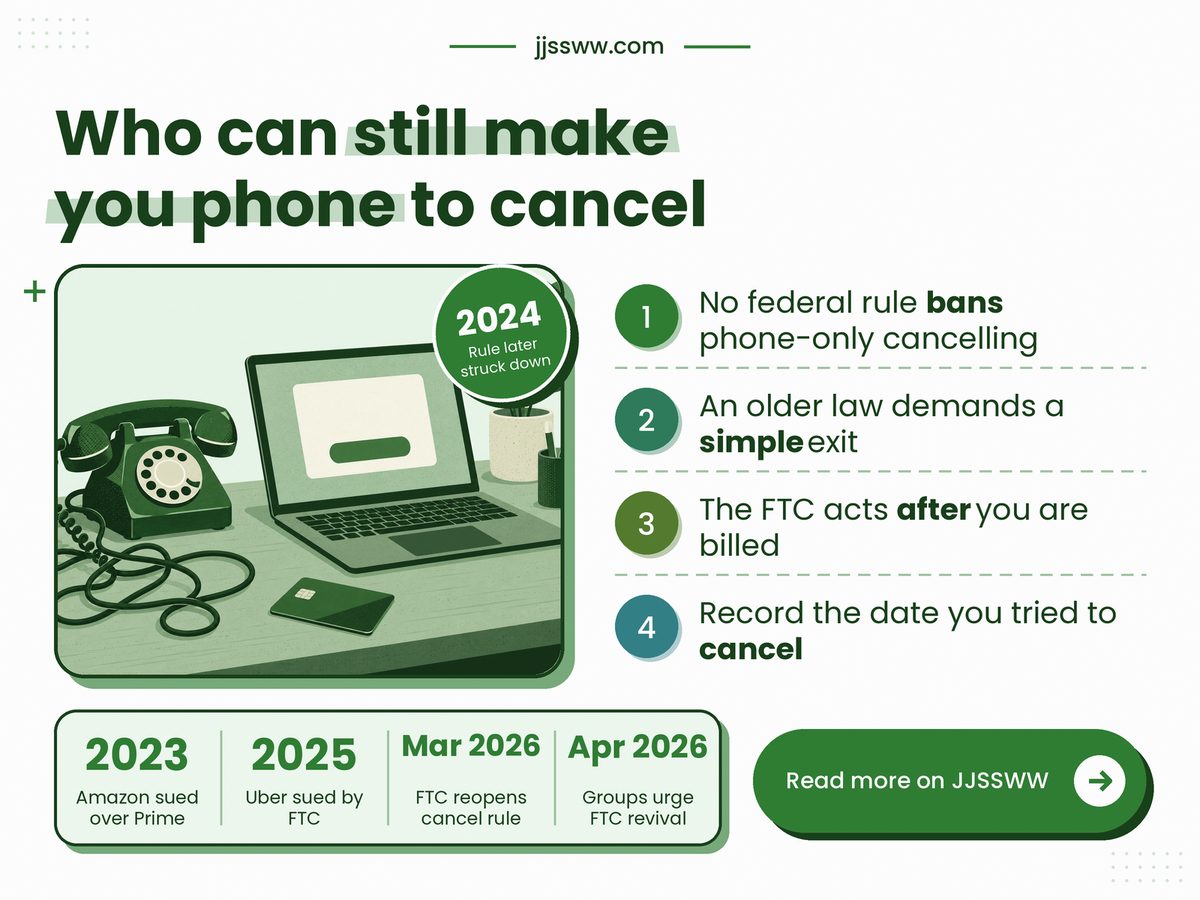
TL;DR: no federal rule stops a company making you phone to cancel, but older laws and some states still limit it.
- The FTC's 2024 cancellation rule has no force; its replacement is only being planned.
- ROSCA, the Restore Online Shoppers' Confidence Act, demands a simple cancel route without defining it.
- California ties cancelling to your signup channel, so an online signup means an online exit.
- Record each cancel attempt, because enforcement follows billing.
Is the click to cancel rule still in effect?
No, a federal court threw out the FTC's 2024 rule on 8 July 2025, and the agency has only restarted the process with an early notice, so nothing federal currently demands an online cancel button.
Latham & Watkins reports that in Custom Communications v. FTC the Eighth Circuit found the agency skipped a required preliminary regulatory analysis, enough to set the whole rule aside. For you, the checklist is gone: no clause to quote at an agent, no deadline for the company. The FTC had already deferred compliance for certain provisions to 14 July 2025, so the ruling landed days before the rule would have bitten.
The agency has not given up. In March 2026 it issued an advance notice of proposed rulemaking, the first formal step toward a new rule, and law firm BCLP calls it the start of a multi-year process. Consumer groups answered in mid-April 2026, the National Consumers League reports, urging the FTC to restore the cancel-as-easy-as-signup requirement. Do not plan around a replacement arriving this year.
I part ways with the cheerful reading that calls the court loss a speed bump. A speed bump you cannot see past for years is a wall, or at least a very long fence. Price rises like Peacock and Apple TV raising prices within days of each other are easier to sustain when leaving costs a phone call. Four numbers show how thin the cover is: two from the rule's timeline, two from the FTC's Prime case against Amazon, announced in September 2025.
Rule Died Before Its Deadline
6 days
Derived: vacated before compliance date
Amazon Automatic Refund Cap
$51
Eligible sign-ups only; rest must claim
Consumers In Refund Pool
35 million
Large group, so payouts stay thin
Average Refund Per Consumer
$43
Derived: refunds divided by consumers
An after-the-fact payout is always a slice of what you paid while stuck, because the pool is shared with everyone else the company caught. A cancel button works before you are billed; a settlement works afterwards, and thinly. Our explainer on why Spotify Premium cannot be paused shows the pattern in a service you may be paying for now.
A court did not take away your right to cancel. It took away the checklist that made that right easy to prove.
Can a company make you call to cancel?
Yes, in many places a company can still make you phone to cancel, unless your state ties cancelling to how you signed up, as California now does, or the phone route fails ROSCA's simple test.
Which rule applies depends on where you live and what you signed up through. Find the row that sounds like you and read across.
| If you | Do this | Because |
|---|---|---|
| ⚖️ In California | Insist on cancelling through the channel you signed up with | AB 2863 applies from 1 July 2025 and makes firms keep your consent record for 3 years |
| ⏱ Stuck on hold | Ask the agent for an email confirmation before hanging up | A written confirmation beats memory if the company bills you again |
| 📊 Charged anyway | Dispute the extra months with the company, then your card issuer | Charges after your first attempt are the amount at stake |
| 🧾 Amazon Prime | Use Prime's own online cancel flow and keep the confirmation | The 2025 settlement bars a cancel process that is difficult or costly |
| 🌍 Anywhere else | Try the account page first, then phone, and note each attempt | Only ROSCA's undefined simple test applies, backed by FTC suits in 2023 and 2025 |
Here is the one-minute check. Open your card statement, find the subscription, and multiply its monthly price by the months since you first tried to cancel. That sum is what a dispute should ask for, and it tells you how much a slow exit has already cost.
A big FTC fine is not your money back: in Amazon's case the penalty and the refunds were separate pots, and only the refund pot reaches customers. Derived from the civil penalty and refund amounts in the FTC's 25 September 2025 settlement announcement, each divided by the total.
Where does the protection break?
It breaks in three places: nothing defines a simple cancel, enforcement arrives after the billing, and refunds reach only some customers, so a company can lose a case while you still lose months of fees.
ROSCA does apply today. BCLP notes that it requires a simple cancellation mechanism but never says what simple means. That vagueness is the whole problem: a long hold is annoying, and whether it is unlawful is something the FTC must argue after the fact. It sued Amazon over Prime and later Uber, each case landing long after customers were charged. Our look at India's dark pattern crackdown shows a regulator targeting exit friction directly.
Refunds are the second break. Missouri Lawyers Media reports that Amazon's automatic payments reach only people who signed up through specified pages; everyone else files a claim. My view, and it is only a view: whether a long hold counts as simple will decide most real cases, and nobody can answer it for you today.
- A cancel button that opens a retention offer or a chat window is not a cancellation until you hold a confirmation.
- California's same-channel rule protects Californians, not automatically subscribers elsewhere.
- Settlement terms bind one company, not the streaming service across the street.
Your cancel route is failing if:
- You signed up in a few taps online, but your account page lists only a phone number.
- You were charged again after a cancel call and have no confirmation number.
- Your billing address is in California and the company offers no cancel route matching your signup.
- You cannot find any cancel option within two minutes of searching your account settings.
So decide per subscription, this week. Open the account page of the plan you most want gone and try to cancel there; if all it offers is a phone number, call now, keep the date and the agent's name, and ask for an emailed confirmation. If the queue wins, see whether your bank can end it, as in our guide to cancelling a subscription from your bank app.
No comments
Post a Comment