Open your banking app and try to kill a charge from inside it. For most of the subscriptions sitting on your card, the app will not let you. It shows the charge, sometimes a tidy list of every recurring payment, then hands you instructions pointing back at the merchant's own website. That is the missing feature, and you pay for it in the months between spotting a charge and actually stopping it. Cancel subscription from bank app works now, but only sometimes, and only for names big enough to make a list.
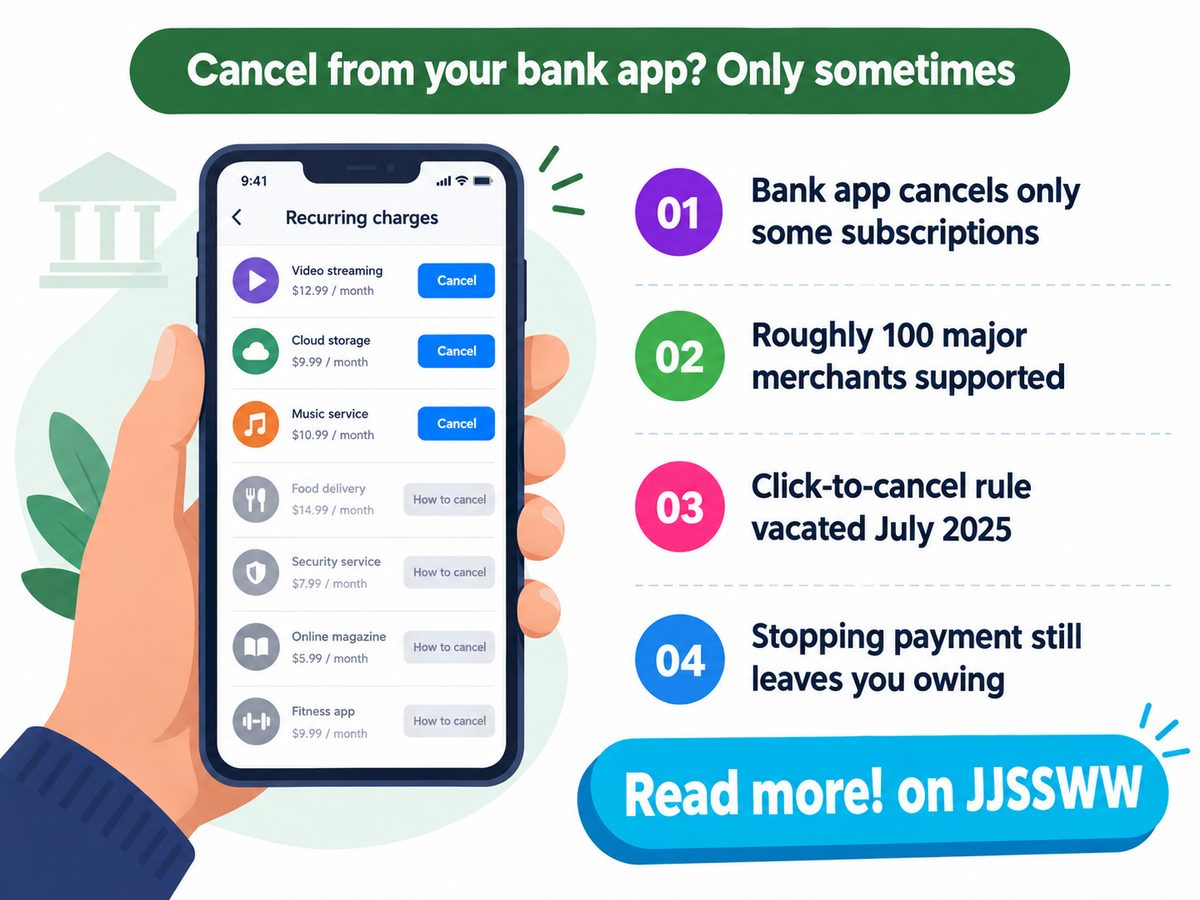
Key Takeaways: your bank app can end some subscriptions for you, and the rest are still your job.
- Visa's cancel panel reached North American issuers through summer 2026, one bank at a time.
- Coverage is a merchant list, so anything off it gets instructions rather than a cancellation.
- No federal rule has forced merchants to accept your exit since July 2025.
- Blocking a payment is not ending a contract, and you still owe the money.
Can your bank cancel a subscription for you?
Sometimes, and only if your card network and your issuer have both shipped the feature and the merchant sits on their supported list, which covers big names rather than the whole of your monthly billing.
Visa announced Enhanced Subscription Manager on 26 March 2026 and said it would reach North American financial institutions through summer 2026, with Latin America and the Caribbean to follow. Inside the banking app you can see every recurring payment, and for a listed merchant you can end it outright. The button therefore arrives on your bank's schedule rather than yours, so two neighbours paying the same streaming bill can have completely different options this month.
This is a deposit retention feature before it is a consumer protection. Or rather, it is both, and the order matters, because the merchants big enough to make someone switch banks get wired in first and the small biller you forgot about does not. Anyone who has watched streaming price rises land quietly on a card statement already knows which charges go unnoticed, and they are rarely the famous ones.
And the reason your bank is offering this rather than the merchant being made to accept your cancellation is that the federal version died. The Eighth Circuit vacated the FTC's click to cancel rule on 8 July 2025 in Custom Communications v. FTC, because the agency skipped the preliminary regulatory analysis required once its own judge found the rule would cost the economy more than $100 million. It had been due to apply on 14 July. So the exit right you were within a week of having never applied at all, and the substitute is a product feature your bank can scope however it likes.
Put those dates next to the rollout and you get the figure that actually describes your position: roughly twelve months ran between the death of the federal exit right and the first in-app cancel buttons, and longer if your issuer sits in a later wave. That subtraction is ours, not a finding from either source. Four other numbers decide whether you can hand the audit to your bank at all, and they come from the court timeline above, the FTC's Amazon refund program, Mastercard's October 2025 work with U.S. Bank, and Deloitte's 2026 Digital Media Trends, fielded in late 2025 with 3,575 respondents.
Federal cushion
6 days
Your exit right never applied.
Price of blocked exits
$2.5B
Repaid years after billing.
Charges per person
8+
More billers than any list.
Yearly churn rate
40%
You quit something most months.
Churn at that level is the part people underestimate. Leaving a service is not an annual chore you can batch, it is a habit, and a panel covering part of your stack means carrying two systems in your head: the one where a few taps end a charge, and the one where you log in somewhere else and hunt for a confirmation email. Anyone already paying for subscriptions scattered across one company's products has met the second system. My own read, and it is a stance rather than a finding, is that issuer merchant lists will grow slowly once the retention win is banked, so I would not wait for yours to cover everything.
Six days. That is the entire life of a federal right to cancel the way you signed up, which is why the exit you use now belongs to your bank instead of to you.
Cancel subscription from bank app: what works and what does not
Two paths sit behind one panel, and the difference is whether the merchant is on your network's supported list, because a listed merchant gets a real cancellation while everything else gets a guided workflow you finish yourself.
The table sets the two paths against each other, using the numbers each network has published plus one threshold that is ours rather than theirs. Read the last column first if you are in a hurry.
| Category | Listed merchant, cancel in app | Everything else, guided workflow | What it means for you |
|---|---|---|---|
| Coverage | 100 plus major merchants via Visa's Digital Enablement SDK | Thousands of smaller billers, instructions only | Open the panel and check before you trust it with a charge |
| Network reach | Mastercard with U.S. Bank: hundreds of participating merchants since 15 October 2025 | Any biller outside those deals | Your card brand decides the option, not the service you pay |
| Proof of exit | Status shown in the app, usually same session | Only the merchant's own confirmation counts | Save the email or you hold no evidence at all |
| Why it exists | 72% want to manage subscriptions in banking app menus | Merchants keep the exit on their own terms | Coverage stops where the deposit win stops |
| Legal backing | None, a product feature your issuer can withdraw | State law only: California since 1 July 2025, plus New York and Massachusetts | Outside those states your exit is whatever is offered |
| Contract effect | Ends the recurring payment mandate on the card | Ends the agreement only once the merchant records it | Stop a charge without cancelling and you still owe the balance |
| Exit trigger | $5 on a $69 monthly bill, about 7%, is where 61% say they quit | Same trigger, slower exit | Price rises reach you faster than the button reaches your bank |
| Best suited for | Anyone whose biggest charges are household names | Anyone billed by small services and app stores | Most people need both paths, so keep your own list |
Read down that last column and the pattern is blunt. The panel is genuinely useful for the handful of charges that are household names, and close to useless for the ones you are most likely to have forgotten. Which is backwards. Forgotten charges are the expensive ones.
Waiting for a regulator to give you your money back is not a cancellation plan, because a year after the largest order of its kind barely half the money had reached people. Figures come from the FTC's Amazon refund program, and the 56 percent share plus the unpaid remainder are our own arithmetic.
Where the in-app cancel button leaves you exposed
The exposure sits in the gap between stopping a payment and ending an agreement, because your bank can block the money while the merchant keeps billing you on paper and eventually sends the balance to collections.
How to stop automatic payments without leaving a debt behind
The CFPB is blunt about the order of operations. Revoke the authorization with the company, then tell your bank in writing. Keep copies of both. A stop payment order can carry a fee, and the agency's own guidance says cancelling an automatic payment does not cancel what you owe. So the cancel button is only ever as good as the merchant's willingness to record the request, which is precisely the duty the vacated rule would have imposed. Regulators have started treating that friction as a design choice rather than an accident, which is the thinking behind the dark pattern rules now aimed at cancellation flows.
Scale the problem up and you reach the Amazon case. The FTC's settlement covers customers who tried to cancel through the online flow and could not, in a window running from 23 June 2019 to 23 June 2025, six years in which every charge cleared on time while the refunds did not exist yet. Signing up keeps getting easier too, and shopping agents that hold your card details will happily add one more mandate you did not diary.
- Your issuer may not have switched the panel on, so check it before you rely on it.
- App store billing sits outside your card, which puts it beyond the panel's reach.
- A cancellation the app marks as done is not proof; the merchant's email is.
- A stop payment can cost a fee and still leave the agreement running.
Four things to check about your own account this week
- Your banking app shows a recurring payments screen, and a cancel control actually appears on it.
- The service you want gone bills your card directly, not through an app store account.
- Your state has an auto renewal law you could cite if the merchant argues.
- Your last cancellation left a written confirmation you can still find today.
So do the work the panel cannot. Open your bank app this week, write down every recurring charge it lists, and mark the ones it will not cancel for you, because those are the ones needing an email trail and a date in your calendar. The decision in front of you is narrow: either you keep your own cancellation list, or you accept that part of your stack bills on until you happen to notice. Keep the list.
No comments
Post a Comment